Wednesday, December 12, 2012

Overcoming an obstacle


The chemistry lab, until a few weeks ago, was my least favourite place to be in. How people could pipette out was a mystery to me and concentrated sulphuric acid was my sworn enemy(well, the thought of heating anything with it and passing the ghastly orangish red fumes evolved into another test tube containing something else still somewhat terrorises me). I was the butt of ridicule and harassment for being unable to pipette out. My first practical exam left nothing but a sour taste in the mouth with me being given a big lecture by a teacher about the importance of volumetric analysis in chemistry practicals. This was because I could not pipette out on the big day as well. They just blew it out of proportion that day. The authorities treated me as if I was not pipetting out on purpose. Just because of not being able to pipette out, it was assumed that I could not do anything in the chemistry lab. Everything in the chemistry lab seemed to be against me. The chemicals, the authorities, my class-mates, everything.

The second term arrived, but my anathema towards chemistry practicals remained. Well, how else do you expect it to be? The first practical session of the term had an excessive blast of concentrated sulphuric acid with us being required to perform the manganese dioxide test for the presence of bromine and iodine in a salt and the copper turnings test and the brown ring test for the presence of nitrate in a salt. Since we were performing the tests for the first time, we were provided with a bromide, an iodide and a nitrate so that we could see the desired results. I gasped on coming to know that all the tests involved concentrated H2SO4. But,I somehow escaped the MnO2 tests that day as I was able to complete only the copper turnings test and the brown ring test by the end of the practical session with my brown ring hardly taking shape. My teacher complained of not enough diluted sulphuric acid. Sigh. Well, I had not completely avoided the MnO2 tests, as my test for iodide was a failed attempt as I had added MnO2 in excess slightly. That drew another complaint from my teacher. Sigh again. After I returned to my desk, she announced that the session was over and I gleefully washed my test tube and hands, took off my lab coat and left the lab. However, the effect of the lab session still lingered due to Mr. Concentrated Sulphuric acid and the amazing smell that he gives off. We are instructed to drink water after every lab session, but despite doing that, my chest felt tight, my head throbbed and whatever smelt bad, smelt like conc. H2SO4. It took 2 periods after the lab session to come back to normalcy. I swore to never enter the chemistry lab without a handkerchief thereafter. First lab session of the second term, nothing different. 

The Dusshera/Navaratari/Puja holidays and the holidays due to Cyclone Nilam came and went and the second practical session of the term arrived. Surprisingly, I left the lab that day with a smile on my face as I had, for the first time, been successful in whatever I did in the lab. The tests for acetate, sulphate and phosphate went on smoothly. Similarly, the next 2 lab sessions went on smoothly with sulphide, sulphite,oxalate, the basic radical tests(the golden spangles formed after performing the potassium iodide test for the presence of lead were wonderful to look at) and the practices that the lab people gave us to find out the unknown acid radical in a given salt. Salt analysis had never been much of a problem for me,but the fear receded and I grew in confidence. I mastered boiling distilled water with the given salt and sodium carbonate to prepare the sodium carbonate extract for wet tests. I also mastered heating solutions in a test tube. I grew to like Salt analysis, not fear it.

But, there was one thing that had yet to be conquered. Pipetting out. The words that haunted me in the 1st term. But, I was determined to set that one right as well as being able to pipette out is very crucial in volumetric analysis. The day my teacher taught redox titrations in class, I went home and told my mother that I had to practise pipetting out at home to set that problem right. So, my mother bought two pipettes and I practiced. I was able to pipette out the first time I did it at home and even had a few episodes of tap water going into my mouth. I practised and practised and finally grew in confidence. My mother assured me that despite the pipette at home being thicker than the pipette in school, I would be able to pipette out during the exam as it is easier to pull a liquid through a thinner medium than a thicker one. If I was able to pull it through the one at home, then I would definitely be able to do it during the exam. My mother also assured me that due to the in-built defense mechanism of humans, NaOH would not go into my mouth.

The day of the chemistry practical exam dawned(last Wednesday). I was thorough with all the salt analysis procedures and entered the lab in a good frame of mind. I took my seat, noted down the questions and began my volumetric analysis. The sight of NaOH racing up the pipette filled me with joy. The first time I did it, the colour of phenolphthalein did not disappear despite the reading on the burette going past 17(disappearance of the pink colour denotes the end point), so I washed the conical flask, refilled the burette and pipetted out again. This time, I ended up with a value of 19.1. I was very happy. Before entering the chemistry lab, I had told my teacher that I was able to pipette out. She was happy and asked me when she called me for my viva assessment how I practiced pipetting out. I told her how. The viva was not that good; I got 3 and a half, but a lot was learnt. The teacher had asked the same core experiment(study of shift in equilibrium) as she had asked before and I creamed it. I could not believe my eyes when a white precipitate was formed and a brisk effervescence was produced when I added diluted HCl to my salt. My salt was a carbonate; the radical which requires the easiest test to confirm its presence in a salt. The salt looked like baking soda and when I added dil. HCl, it was confirmed that the salt was a carbonate. I had avoided Mr. conc. H2SO4. Let him rest for a while. I am not that afraid to face him. I went home with the satisfaction of having had a great chemistry practical exam.

I am no longer afraid of the chemistry lab. I am happy that I have finally overcome this obstacle.

(Also posted on the blog "Pursuit of Boredom")

Tuesday, December 11, 2012

The Heroes of Olympus: What's next?


With the third book of the Heroes of Olympus series, the “Mark of Athena”, to be released in August this year, let’s have a look at what could lie in store for us next in this fascinating and intriguing series by Rick Riordan:


NEXT STOP: ROME

After traversing the landscapes of the eastern and western coasts of the United States of America in the first 2 books, we all know that this time we are going to be switching continents from North America to Europe as the giants intend to “pull the Gods out from their roots”. The roots of the Gods lie in Greece, but hey wait, we are not rushing to there now. Remember, for the demigods to beat the giants, demigods and gods have to work together. But the demigods have lost the trust of Zeus, the king of gods, due to a slight ego issue. After Titan War II, Zeus apparently felt bad that the world had been saved by the demigods, at the end, and not them, the gods. So, he closed the doors of Olympus for a while and disallowed communication of the gods with their children. For these demigods to beat the giants, they need the help of the gods and therefore have to win back Zeus’s trust. To do this, these demigods have to go to the Doors of Death and seize its ownership from Gaia, making this the final before the final and the most crucial clash. The location of the Doors of Death is in Rome and has to be guided to by a child of Pluto (which obviously has to be Hazel, not Nico as he has been captured). From this, we can gather that we are going to stop over at Rome next. After winning back Zeus’s trust, we go over with confidence to Greece in the 4th book to witness the ultimate clash: The demigods with the gods against the Giants.

THE SEVENTH DEMIGOD

All of the 7 demigods in the elite team to take on Gaia have been found, except for the 7th one who has not yet been disclosed by the author. But, I strongly feel that the 7th demigod is none other than Annabeth. Hera mentions in Percy’s dream at the end of the Son of Neptune that Annabeth has a difficult task when they land at Rome and she may cause problems in the quest. One of the prophecies that Ella recites in the Son of Neptune says, “Wisdom’s daughter walks alone, the Mark of Athena burns through Rome”.  The only demigod in the book who is a VIP and a child of Athena is Annabeth. Although Hera and Annabeth dislike each other, I think Hera would have recognized the fact that Annabeth is one of the best strategists they could ever find. This aspect, she would have felt, could come very handy in the quest. So the 7 demigods, in my opinion, are:

i)             Jason Grace- Son of Jupiter
ii)           Percy Jackson-Son of Poseidon
iii)          Piper McLean- Daughter of Aphrodite
iv)          Frank Zhang-Son of Mars and descendant of Poseidon
v)           Leo Valdez- Son of Hephaestus
vi)          Hazel Levesque- Daughter of Pluto
vii)        Annabeth Chase- Daughter of Athena

Looks quite a list, doesn’t it?

FROM WHERE DOES THE BOOK START?

The previous book ends with the bronze warship carrying the Greek demigods involved in the quest along with Jason Grace preparing to descend onto the Roman Forum in New Rome at the Roman Camp. So, one would suspect the next book would begin with the warship finally descended onto the Forum and the Greek and Roman demigods on the quest allowed to explain their cause. Then, they would proceed to Rome.

OTHER CHARACTERS TO WATCH OUT FOR AND THEIR DESCRIPTIONS

i)             THALIA GRACE- Daughter of Zeus and chief huntress of the Hunters of Artemis. Sister of Jason.
ii)           REYNA- Praetor of the 12th Legion and Daughter of Bellona(The Roman war Goddess).
iii)          ELLA- The smart harpy who loves books and has memorized the Sibylline Books.
iv)          QUEEN HYLLA- Daughter of Bellona and the Queen of the Amazon. Sister of Reyna.
v)           NICO DI ANGELO- Son of Hades who has mastered the nuances of the Underworld. Known as the “Official Ambassador of Pluto” in Camp Jupiter. Has learnt his way in the world of demigods via experience. He could have played a very important role in the part of the quest that involves Rome had he not been captured by the forces of Gaia. Could play an important role in the quest post Rome.
vi)          TYSON- The friendly Cyclops who belongs to the good side. Half-brother of Percy and General of the Army of Poseidon.
vii)        RACHEL ELIZABETH DARE- A mortal gifted with sight and the official oracle of Camp Half-Blood. Close friend of Annabeth and Percy.
viii)       CHIRON- The wise, old centaur who has trained demigods for centuries. Son of Kronos and official director of Camp Half-Blood.
ix)          GROVER UNDERWOOD- The satyr who is a close friend of Percy and Annabeth. He has an empathy link with Percy.
x)           The rest of the Amazons and the Hunters of Artemis
This should be a fascinating book and lets keep all our eyes and ears open for its release in August!

(Written on 26th March 2012 for the blog "Pursuit of Boredom")

A summary of the Heroes of Olympus series so far


The Prophecy:
“7 Half-bloods shall answer the call,
To storm and fire the world must fall,
An oath to keep with the last breath,
And foes bear arms to the Doors of Death.”

The new series “The Heroes of Olympus” by Rick Riordan, as we all are aware, revolves around the Second Great Prophecy - which we all heard of in the last pages of the final book of the Percy Jackson series - coming true. This time it is the oldest forces, Gaia and her army of Giants who are the antagonists. The protagonists are our old friends from Camp Half-blood- Percy Jackson, Annabeth Chase, Grover Underwood, Chiron, the Gods, Rachel Elizabeth Dare, etc.- coupled with some new demigods. This time Riordan has added a new dimension to the brilliant world of Percy Jackson- Demigods are classified into Greek and Roman. This is because the Gods transform into different forms- Greek, Roman and American- as they are immortal. However, the origin of the Gods remains
in Greece (For more details and better understanding, please refer to the Lost Hero, book 1, in the part where Annabeth takes Jason to the Hypnos cabin to meet Clovis).

The plot

Defeating Gaia is a Herculean task, therefore, this would require the world’s best Demigods to challenge her and her army of Giants. Now, this elite team of 7 half-bloods who answer the call to oppose Gaia are spread out across both the Greek and the Roman camps. These demigods will have to unite to make this possible. But this was easier said than done as the Greek and the Roman demigods had been involved as the 2 sides in a bitter civil war several years ago which had resulted in the Gods separating both the Camps and making sure that they don’t meet each other during quests. Camp Jupiter, the lovely Roman Camp is situated on the west coast of America, in San Francisco, which is also another reason why that is a bad place for Greek demigods. The proverb “United we stand, divided we fall” made Hera (known to Romans as Juno), the queen of gods devise a plan to unite both sides. She decided that the first step to unification was the two sides to trust one another again, therefore, she had two demigods, one Roman and the other Greek, who belong to the 7, to exchange camps at the right time and make a mark in the minds of the members of both the camps. For this plan to work, the identity of these two half-bloods is to not be revealed until the end, of course, so that they don’t begin a war. For this, she blanked the memories of both these demigods until the end of their quests. Our hero, Percy Jackson, who disappeared from the Greek camp to arrive at the Wolf House in Sonoma Valley- which is from where every Roman demigod begins his first journey to Camp Jupiter with being under the tutelage of Lupa, the immortal she-wolf who raised Romulus and Remus –, happened to be one of these 2 demigods. The other, is a new demigod: Jason Grace, Son of Jupiter (Known to Greeks as Zeus) and brother of Thalia. He disappeared from Camp Jupiter to arrive in a school bus- which carried 2 other Greek demigods who are a part of the 7- as “the special package”. That bus was on its way to the Grand Canyon and from there, the three were taken to Camp Half-Blood. The first book, the Lost Hero, revolves around Jason Grace’s sojourn at Camp Half-blood and how he makes a mark in the minds of the Greek demigods. The second book, the Son of Neptune, revolves around Percy Jackson’s sojourn at Camp Jupiter and how he makes a mark in the minds of the Roman demigods.  In the process, we are introduced to the other demigods who are the part of the 7 (Piper McLean, Leo Valdez, Hazel Levesque and Frank Zhang), new characters and some new concepts. However, the 7th demigod has not yet been disclosed.

Conclusion

The plan to overthrow Gaia would be for these 7 to sail to Greece, the place of origin of the Gods, in a magnificent bronze warship which can fly as well as sail, to stop the Giants from uprooting the Gods from their roots and on the way stop over at Rome. This would be covered in the next books, which have not yet been released. The 3rd book of the series, “The Mark of Athena” is to be released in the fall of this year. All this has made for some intriguing and fascinating reading, which makes us agree with Juno that this quest would be the greatest quest of all time since Aeneus sailed to Troy. I cannot wait for the next book to be released. To conclude with some Latin, I would like to say that this series is a “magnum opus” of Rick Riordan.
(Written on 21st February 2012 for the blog "Pursuit of Boredom")

Thursday, February 2, 2012

CHETESHWAR PUJARA-A FINE PROSPECT FOR THE FUTURE OF INDIAN CRICKET


It was evident during Australia’s 4-0 drubbing of India that Rahul Dravid and VVS Laxman are definitely past their prime. The truth was there for everyone to see and it is quite clear now that it is time for young Indian batsmen to make their way into the Indian batting line-up and build a new India. Amidst all the touting of Virat Kohli, Rohit Sharma and Ajinkya Rahane as the men of tomorrow of Indian Cricket, I hope the selectors have not forgotten a debutant who played a crucial role in the test victory against Australia at Bangalore in October 2010. Not that Virat Kohli, Rohit Sharma, Ajinkya Rahane, etc. are any less capable, but this particular player is as capable as they are and would have definitely featured in all the test squads after the tour of South Africa had injury not intervened. This young Indian batsman is Cheteshwar Pujara.


MAKING A MARK
Hailing from Saurashtra, Pujara first made his way into the good books of the selectors after some fine and consistent performances in first-class cricket and in India-A tours. With poor form ruling out Yuvraj Singh from the test squad against Australia in 2010, he first got selected in the team as a back-up middle order batsman and was made to warm the bench for the 1st test at Mohali which resulted in a miraculous victory for India. But opportunity soon dawned on Pujara. The man who played the most crucial role in the Mohali victory, VVS Laxman, pulled out of the 2nd Test at Bangalore with a back injury and Pujara was asked to replace him in the batting order. After sitting in the dressing room for more than 2 hours with his pads on due to a mammoth 303 runs partnership between M. Vijay and Sachin Tendulkar, he faced his 1st ball in test cricket off Mitchell Johnson, which he hit for a 4 through mid-wicket. But the very next ball resulted in a sad thing: he was out, lbw. But there was more to the story of his test debut.

Cheteshwar Pujara pulls during that unforgettable innings of 72

 The match entered a decisive and interesting stage on day 5. Virender Sehwag was out, India required 200+ to win and the whole world expected the usual man at no. 3, Rahul Dravid, to stroll out of the dressing room and take guard. But that was not to be. Instead of Dravid, it was young Pujara coming out at no.3 and many were surprised. Pujara had a very positive approach in his batting from the beginning, not afraid of the occasion, and played some excellent shots. His technique struck me. THWACK, THWACK, THWACK, he pulled Mitchell Johnson’s short balls to the boundary. Those shots remain fresh in my memory. He made a well-crafted half-century and guided the team forward with M. Vijay and Sachin Tendulkar giving him company at the crease. The coach’s and the captain’s decision to send him instead of Dravid at no. 3 was vindicated. Dravid was not in form before that match and was out early in the first innings, so probably the team thought of sending Pujara at 3. For whatever reason that decision was taken, it paid off in the end. Unfortunately, his entertaining and positive innings had to end when he was on 72. But he had done his job before he left, so I had to say, “Well played, young man”. Dravid came in at 5 and joined Tendulkar after Pujara’s departure and the duo maintained the positive approach. They brought about the victory for India and Pujara had played a crucial role in it. I was very impressed. In the test series in South Africa, he finally got his chance in Durban replacing an out of form Suresh Raina at no. 6, after being used for drinks, towels and substitute fielder duty in the previous 4 tests. He also played in the subsequent match at Capetown. Although he did not score many runs in that series, he showed powers of temperament and fight by sticking it out with VVS Laxman during his decisive innings of 96 in India’s 1st innings at Durban in tough circumstances, tough conditions and against great bowlers like Steyn and Morkel. After seeing all this, there is less doubt in my mind that Pujara is the candidate to replace Dravid at no. 3 in Tests.

CHARACTERISTICS OF A NO. 3
When we think about Test batsmanship, immediately the words “technique” and “temperament” come to our mind. Especially when we are thinking about batsmanship at the no. 3 slot. Is there any doubt that Pujara has those traits? I don’t think so. The general idea about the role of a no. 3 batsman is that when an early wicket falls, he should be able to negotiate the new ball and then take it forward. Pujara can do that. During the recently concluded Border-Gavaskar series, Ian Chappell mentioned a very good point about batting at no. 3. He said that a no. 3 batsman should be able to take the team and the game forward with his batting. Being a batsman who is adept in attack and defence, Pujara is capable of doing that. Also, most importantly, he has a cool mind and is not afraid of anything. Therefore, I think he is suitable for the no. 3 position in Tests.

He is now out of injury and has played a few first class games. So, I expect to see him in the squad for the next Test series. With a new horizon in sight for Indian cricket, players like him are surely the need of the hour. 

Sunday, October 16, 2011

Some inspirational quotes


 "The future", they say, "belongs to those who believe in the beauty of their dreams"

"Courage does not always roar. Sometimes courage is the quiet voice at the end of the day saying, 'I will try again tomorrow'." -Mary Anne Radmacher

"Strength and growth come only through continuous effort and struggle"

" The journey of a thousand miles begins with one step" - Lao Tzu

"You see things; and you say, 'Why?' But I dream things that never were and I say, 'Why not?''" - George Bernard Shaw

"Remember all things are possible for those who believe" -Gail Devers

"Live life to your fullest potential and fight for your dreams"- Ashley Smith

"Dreams are like stars...you may never touch them, but if you follow them, they will lead you to your destiny"

"Whatever you can do or dream you can, begin it. Boldness has genius, power and magic  in it." - Goethe

"Don't be pushed by your problems, be led by your dreams"

"Dreams are pure thought, an opportunity to discover yourself"

Ludwig van Beethoven was a German composer and pianist whose hearing began to deteriorate in  his 20s. Despite increasing deafness, Beethoven continued his work and wrote prodigiously. He composed inspiring pieces of music and continued to conduct and perform even after losing his hearing completely. He believed in the beauty of his musical compositions inspite of not being able to hear it himself - one of the reasons why he remains to be one of the most acclaimed and influential composers of all time.

When Elvis Presley, an American musician, actor, was enrolled at Humes High School, his music teacher gave him a 'C' in music in eighth grade and told him he had no aptitude for singing. The next day, the teenage Presley brought in his guitar and sang in an effort to prove otherwise. By the time he graduated high school in June 1953, Presley hadalready chosen music as his future. Presley, who never received formal music training or learned to read music, sold over 300 million albums during his lifetime and became world renowned as the King of Rock and Roll.

The Wright Brothers, Orville and Wilbur, were two Americans who in 1903 were the first to make brief sustained and controlled powered flights in an aeroplane, which was designed and built by them. In December 1903, the Wright brothers took their wood and fabric biplane to the sand dunes of Kitty Hawk, North Carolina. Their historic flight - the first powered airplane flight - covered 120 feet and was air-borne for 12 second before landing. The next time they built the plane, they invited the press. Unfortunately, the plane failed to lift off. European newspapers, especially in France, ridiculed them openly, and a vast majority of people, especially in Europe, continued to consider the Wrights as liars. The Wrights stopped flying in November 1905 and made no flights at all during the next two years. Confident of their dreams, when they resumed flying in 1908, they did not only astonish the sceptics but also taught the world the way to fly.

In their own way, all these people set and example of fulfilling the dreams they believed on...an example we could all do well to follow in our lives as well.


Not written by me, just found all this in some of my notebooks. Thought they were really great and applicable to people in all walks of life, so I decided to transfer them here so that everyone can see. Classmate notebooks are a class apart!


Sunday, April 3, 2011

India conquer the world

Disclaimer:This post was published when I was 14 years old. I think this post reflects what a 'chamathu' kutti papa I was :p. I mean, this is one of the posts that really shows what an innocent child I was, so please bear with some of the language used. :p


Well, I don’t know what to say. WE ARE WORLD CHAMPIONS! It took some time for it to sink in, when it did, it was an amazing and elated feeling. No words to describe that feeling. When M S Dhoni hit the winning runs, as the ball soared up into the air into the stands, a 1.2 billion hearts soared with it and they continue to be up in the air long after the ball landed in the stands to register a win. After he hit the winning runs, he paused as if he had not realized what he had just done – he had just done a 1.2 billion people so proud. Only when he saw Yuvraj Singh sprint from the non-striker’s end to embrace him did he begin the celebrations. When the ball landed in the stands, down the players’ cheeks went tears of happiness, out came the emotions on the support staffs’ faces and up went the crackers as a symbol of the emotions of a 1.2 billion people. CHAK DE INDIA!
Yuvraj Singh, the man of the tournament. No surprises there. Before the tournament, he was woefully out of form and it clearly was the worst phase of his career. But, as the saying “Cometh the hour, Cometh the champion” goes, Yuvraj rose to the occasion magnificently in the World Cup. He scored over 300 runs and picked up 15 wickets in the entire tournament. Before the World Cup, he would not put value to his wicket; he had put on weight and would not field at his usual position at backward point. But in the World Cup, he batted with great maturity and wanted to put value to his wicket, went back to fielding at backward point and always made sure to be the captain’s go to man whenever a wicket was required.  Hats off to his father Yograj Singh, his guruji and all the people who helped him in his rough phase.
This World Cup victory was not all about Yuvraj Singh; every member of that 15 man squad had a contribution to it. We gave everything to it and we totally deserve this victory. It was sheer teamwork.
There is one unsung hero : Coach of the team, Gary Kirsten, the man who worked behind the scenes. Four years ago, the Indian cricket team was in absolute turmoil. Early exit from the World Cup 2007 and the demoralising presence of Greg Chappell in the dressing room had left the team in absolute tatters. Gary Kirsten started work as so...on as... he was appointed the coach of the team during this horrible phase. Kirsten resurrected the team from shatters, brought self-belief back into the team and got them together as a team. Four years ago, no-one believed that the team would come out like this. Gary Kirsten, a soft-spoken man from South Africa, has spoken volumes for the team. It is sad that he is ending his tenure as a coach after the World Cup, he has done so much for the boys, but it understandable because he has a young family back home in SA. Coaching is not an easy job, you have to travel with the team 24 x 7. Hats off to you Gary! What a way to sign off as a coach!
This World Cup was probably Sachin Tendulkar’s last World Cup. And what a swansong it was. Sachin has equaled Javed Miandad’s record for participating in 6 World Cups, all this time he yearned for one thing: a World Cup. It has finally happened now. It is a dream come true for him to lift the World Cup in front of his home crowd in Mumbai. He has now got practically every cricketing record throughout his glittering career, except the one which is waiting for him : a 100thton in International Cricket. Lets not put too much pressure on him to get it, when he does, we will all celebrate. I want him to get it when the team goes to England this year, in the match at the Lords’ Cricket Ground, the home of Cricket. But, lets hope for the best. This World Cup has elevated Sachin to a higher position. Hats off to the team for making this happen to the greatest batsman this decade has seen. Virat Kohli got it absolutely right when he said that Sachin has carried the burden of the country for a long time and it is now time for them to carry him. It was a very emotional moment for all Indians when Sachin Tendulkar was carried around the Wankhede.This World Cup for you, Sachin! For all the things you did for India, Indian Cricket and World Cricket.
M S Dhoni, the captain with the Midas touch. It is true in a way. We became the “Kings of the three worlds” under his captaincy – we got the no. 1 ranking in the ICC rankings for Test teams, we won the World T20 2007 and we won the World Cup 2011, going up to the no. 1 ranking in the ICC rankings for ODI teams in the process. Chennai Super Kings won the IPL and the Champions’ League under his captaincy. There is something very special about that man. The World T20 2007 was the first assignment for M S Dhoni as a captain. We went on to win that tournament, and everyone knew at that time that he was something special, because not everyone succeeds so well on such a big stage, that too in their very first stint with the job. Not for nothing he is called Captain Cool. The way he batted yesterday when the team was under pressure and many more occasions suggests us. Many were surprised when he came up the batting order yesterday, but I was not. His coming at no. 5 and not at no. 6 made a lot of cricketing sense (to form a left-hand & right-hand combination at the crease, to make the fielding captain think and because off-spinners were bowling at that time) and there was one more thing which I liked about him coming up the order; he took the responsibility, as a leader, to come to the aid of the team when it was in trouble. If we can see, there is a perfect blend of young and senior players in the team. Dhoni manages them very well without applying too much of pressure. He is pretty instinctive with his decisions and takes a lot of gambles, but when his instincts don’t prove right, he accepts his mistakes and that a great quality to have. He inspires his team-mates with his activities.All these are the marks of a good leader. M S Dhoni – the true spirit of leadership.
Imran Khan, the 1992 World Cup winning captain, made a very good point about pressure. He said that pressure matches during the knock-out stages during the tournament helped India handle the pressure during the finals. We faced Australia and Pakistan in the quarter-finals and the semi-finals respectively, and facing these two teams during the knock-out stages of such a big tournament involves quite a bit of pressure and we handled it pretty well. Certainly, the experience of tackling that pressure, helped us with the pressure in the finals when the chips were down, after our bowlers were given a pasting in the last five overs at the hands of Jayawardena, Nuwan Kulasekara and Perera and after we lost Sachin and Sehwag early to Slinga Malinga. The way Gambhir, Kohli and Dhoni batted under pressure was superb. They held their nerve and batted sensibly, they bisected the field, they ran hard between the wickets and did not allow the spinners – Murali and Randiv – to settle. When the dew came on, it became all the more difficult for the bowlers. Gambhir batted beautifully, but had himself to blame for getting out, that was not the shot to play that ball, nevertheless, it was a brilliant and a crucial knock. Dhoni lead from the front and inspired his players. Yuvraj Singh finished it well along with Dhoni. 
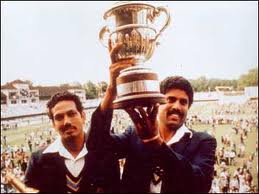
On June 25th 1983, Kapil Dev lifted the trophy for everyone present at the Lords’ Cricket Ground to see. 28 years later, on April 2nd 2011, the same feat was emulated by M S Dhoni & co. To me, both the wins were special, not just yesterday’s. When we won the World Cup in 1983, no-one expected India to win, and we did. That beautiful summer of 1983 changed the course of World Cricket and Indian Cricket. Kapil Dev led a young team to World Cup victory, he made them believe that they could win the tournament and told them to make a fight out of it. They beat West Indies in the finals – West Indies, in those days was the best team in World Cricket. They fought it out against the best players and won. That was a memorable moment. When we won the World Cup in 2011, we went into the tournament as favourites for the trophy and we lived up to that billing. The fact that this win means so much for the country, makes it so special. This could well be a beginning of a new era in cricket. Kapil Dev’s running catch to get Viv Richards out off Madan Lal’s bowling in the 1983 final is as special as Dhoni’s six off Nuwan Kulasekara to win the 2011 final.
As for Sri Lanka, well-played. It is not easy to come to a World Cup final and they came. They should be proud of their performance in this World Cup. It just was not their day yesterday. Murali could not end his career on a high with a win, but he has done great things for Sri Lankan Cricket and for World Cricket. Unlike Sachin, he had already had a World Cup before, in 1996. Nevertheless, Murali too is a legend of the game. Murali was injured and tired yesterday, that is why he could not get as much zip as he normally gets. My second case for the “Cometh the hour, Cometh the champion” quote: Mahela Jayawardena. Before yesterday, the Sri Lankan middle order was a matter of debate among experts and a matter of concern amongst Sri Lankan fans. True, there was indeed a problem with the middle order, and amongst that discussion Jayawardena’s name was also mentioned since he had not scored many runs since the first game against Canada. But, yesterday, when Sri Lanka were in trouble, he rose to the occasion magnificently and scored one of the finest ODI hundreds I have ever seen. He was there till the end of the innings, shepherding Nuwan Kulasekara and Perera – lets not forget the role of the 2 of them in Sri Lanka’s total yesterday. Unfortunately, Jayawardena’s innings could not turn out to be a match-winning one. 
In this World Cup, we have seen some incredible cricket and have had some great moments when we were proud to be cricket fans. The tournament was a huge success. Ireland’s win over England, the centuries made by many players and of course, as an Indian, India winning the World Cup, would stick with me for life. To me, this tournament showed the supremacy of Asia, not only in terms of viewer ship, but in the terms of the Cricket played as well. I was very proud that two Asian teams made it to the finals. The 1970s and the early 1980s witnessed the first chapter of Cricket supremacy: The West Indies and the late 1990s and the early 2000s witnessed the second chapter of Cricket supremacy: Australia. This could be the beginning of the third chapter: Asia. To me, the performances of two teams in this tournament were something which came entirely out of the blue: New Zealand and Pakistan. Both of these teams, before the World Cup, had serious off-field issues which were impacting on the field and both of them were not expected to make it to the World Cup semi-finals and they did. It has been great fun for 6 weeks.
1975 and 1979: West Indies under the captaincy of the Clive Lloyd
1983: India under the captaincy of Kapil Dev
1987: Australia under the captaincy of Allan Border
1992: Pakistan under the captaincy of Imran Khan
1996: Sri Lanka under the captaincy of Arjuna Ranatunga
1999, 2003 & 2007 : Australia. 1999, under the captaincy of Steve Waugh. 2003 and 2007 under the captaincy of Ricky Ponting
2011: India under the captaincy of M S Dhoni
Krishnamachari Srikkanth has had the unique distinction of being a part of a World Cup winning team in 1983 and being the chairman of selectors of the World Cup winning team of 2011. I will remember World Cup 2011 forever. The final of the World Cup 2011 was a great game of cricket and it befitted a World Cup final. The better team won. It was a combination of teamwork and skill to get Team India through. As Imran Khan said, the winning has been happening for quite a while now, in the build up to the tournament. 2nd April 2011 will be in the hearts of Indian Cricket fans for a long time.

Tuesday, February 15, 2011

India's chances at the ICC Cricket World Cup: A detailed analysis

Disclaimer:Another post that was published when I 
was 14 years old. Another portrayal of childish innocence, I think. So, I again request you all to yet again bear with the language used. :p 


It was a memorable day for Indian Cricket way back on June 25th 1983, when Kapil Dev, the then captain of India, lifted the World Cup trophy for all present at the Lord’s to see. Truly, 1983 is a stamp in memory for all Indian Cricket lovers. Now, there is hope in every Indian heart that this feat would be achieved again 28 years later, but, only time can tell whether it will happen or not. According to me, India stands a very good chance for the coveted title this time, in 2011. India is playing the World Cup in the Sub-continent which makes them familiar with the conditions but there are more reasons, which I will be mentioning. India has quite a good side on paper. Anyway, there is no point in talking about selection now as it is already over and nothing can be done about it. Execution is what matters now.
SQUAD:
Virender Sehwag (VC), Sachin Tendulkar, Gautam Gambhir, Yuvraj Singh, Virat Kohli, M S Dhoni (C & WK), Yusuf Pathan, Harbhajan Singh, Zaheer Khan, Munaf Patel, Sreesanth (as a replacement for Praveen Kumar),Suresh Raina, Ashish Nehra, Ashwin and Piyush Chawla.
 BATTING:
 The World Cup is taking place in the sub-continent, where pitches suit the batsmen more and India arguably has a world-class batting line–up. Anyone who goes through it right from the top order – with Sachin and Sehwag opening and Gambhir coming in at 3- and all the way down to the middle and lower middle order would say that it is the best batting line-up in the tournament on paper. The names of the top order – Sachin, Sehwag and Gambhir- are self-explanatory. The form of Virat Kohli is a huge plus point considering his performances in the recent past where he has thrived under pressure and has displayed the right temperament and the maturity to hold the innings together in the middle order. Adding to it, Kohli is an electric fielder. Yusuf Pathan – the man who sends shivers down bowlers’ spines whenever he walks out to bat– made a comeback into the team at the right time and immediately made an impact. His game-changing maiden century vs. New Zealand, his half-century which also turned the way things were going in the 3rd ODI at Capetown and a century that went in vain at the Centurion is testimony that he is raring to go. A man who can single-handedly turn around the fate of matches coming down the order is always a plus point in any team. True, he can play rash shots and get out, but that’s the way he plays, we cannot do anything about that and we should see whatever positives he brings to the side. Any questions regarding his short ball problem were answered when he hit even short balls for sixes in the final ODI at the Centurion. Also, I feel such players with this degree of talent should be allowed to play the way they play as then only they thrive, such is the case with Yusuf. He is also a useful part-time off-spinner, which gives more options to Dhoni. Some men down the order – Harbhajan Singh, Ashwin, Piyush Chawla, and Zaheer Khan – can also contribute with the bat, which is another plus point. Although the batting was not up to the mark in the ODI series against South Africa, it can be taken note that they played in the absence of the regular top order and that that series was in South Africa and not in India, which is co-hosting the show piece event and the batsmen would be comfortable with the pitches in the sub-continent. Also, it is better for them to look at the brighter side of things before the World Cup and concentrate only on the World Cup, which they would obviously do and are doing considering the signals from the training camp.


BOWLING:
PACE DEPARTMENT:
The pace department in the World Cup will be obviously led by Zaheer Khan. As everyone is aware, he is not only a class bowler, but also a great mentor for the other pacers­- which is a great boost. Also, as M S Dhoni said, he always has a plan in hand. As Harsha Bhogle said, a fit Zaheer Khan can be really very dangerous. Munaf Patel has been in good form over the last 2 series; proof, his 4 wicket-haul at the Wanderers against South Africa in that miraculous victory and his performance in the ODI series vs. New Zealand. As everyone knows, he is a different kind of bowler who does not concentrate much on pace, but concentrates a lot on accuracy which has paid rich dividends. Although not much bounce will be provided by merely hitting the deck in the Sub-continent, Munaf obviously knows how to bowl the way he does on sub-continental wickets. Praveen Kumar, one of our main ODI bowlers, was unfortunate to have picked up an elbow injury during the one-off T20 match between India and South Africa and further aggravation forced him to be ruled out of the tournament. But, he has been replaced by Sreesanth, who has got his chance. He deserves to get it and I am happy for Sreesanth. Sreesanth is also a good bowler who is a natural outswinger of the ball and can also reverse it when required. He can be really dangerous when in rhythm and is a wicket-taking bowler, only thing he can get a bit temperamental at times. His economy rate in ODIs and his ODI record are not very good, but it will be wise for us not to judge him on that basis. He is an improved bowler now and not like the way he was. Also, the way he bowled in the ODI series vs. New Zealand was very impressive, especially the 1st match in which he produced wicket-taking deliveries to finish off the match, also, he was impressive in the warm-up match against Australia. Not only that, we must remind ourselves that this is cricket that they are playing, so we will just have to wait and watch how he bowls on the field, i.e.; if he gets a chance in the playing XI. Sreesanth maybe a little too Test match suited, but he will learn.
SPIN DEPARTMENT:
As the World Cup is taking place in the sub-continent, every team would look to have their spin department decked up. The spearhead of the spinners would obviously be Harbhajan Singh. Although he was not in the peak of his bowling form for some series and was a bit defensive in his approach, he bowled well in the ODIs vs. South Africa, especially at the Wanderers during the middle overs. As Harsha Bhogle said, Harbhajan should be assuming the wicket-taker’s role. Ashwin impressed one and all in the only 7 ODIs he has played. He brings versatility into the team considering that he can bowl in the death and the Powerplay which is not easy for any spinner to bowl in and he also brings a lot of variety considering he is a thinking bowler and makes use of the carrom ball very well. Some would have questioned his presence in the team due to the presence of part-time off-spinners and Harbhajan Singh; but I would say, although Harbhajan Singh and Ashwin are both off-spinners, their style of bowling is different. Also, even though there are part-time off-spin options in Raina and Yusuf Pathan, they cannot bring the variety that Ashwin brings into the attack. Although he cannot be really judged properly considering that he has played only 7 ODIs, it can be taken note that he is in good form and there is no-one else to fit the bill. Yuvraj Singh brings the left-arm spin dimension into the attack; although he cannot bring that conventional left-arm spin as he is a part-timer, he stops the flow of runs and picks up wickets whenever required and that is more than enough. He too bowled well in the ODI series against South Africa. Also, as mentioned above, we have some really good part-time options in Raina and Yusuf Pathan. Piyush Chawla was a surprise to me considering he had not had many games before the World Cup, but if Dhoni had really asked for him; we had better trust it as majority of Dhoni’s hunches have proved to be right in the past. Besides, we have to accept it now, as nothing can be done about the selection and looking at the brighter side, it is good to have a leg-spinner with a good googly and flipper in the side as it adds to the variety, which is always good. Not only that, he put on a disciplined bowling performance against the Aussies in the warm-up game, mixing up the wrong ones rightly. With this, he puts some competition for the second spinner’s slot with Ashwin, in case the conditions demand it, and this is a good dilemma for the Captain. According to me, India’s spin department for the World Cup is one of the best on paper amongst those selected for the tournament.

OTHER POSITIVES:
Cricket is not only a physical game, but also a mind game. Any tournament of such a large scale such as the World Cup will not come without pressure, so does this World Cup and the Indian Team will be playing at home, thus, expectations from the home fans would be there. But, as M S Dhoni said, this side is better equipped to handle the pressure. Also, the calming presence of M S Dhoni in the dressing room and during times of pressure helps a lot. He has a calm and cool head and not for nothing he is called “Captain Cool”. Speaking of Dhoni, he has the penchant for winning big tournaments such as the ICC World T20, the IPL and the Champions’ League and he follows his gut feel while making any decision, just like the captain who lead India to the 1983 World Cup victory, Kapil Dev. Also, the players respect him a lot. Coach Gary Kirsten, for whom this World Cup would be a swan song, has had a positive influence on the players and is a great man manager - which helps in building team spirit and self belief. He has worked wonders with the team. The players would like to win this World Cup for Sachin Tendulkar – who on all practical purposes would be playing his final World Cup – and Gary Kirsten additional to their want of lifting the Cup for the country. Many have told that the probable playing 11 of the World Cup not playing in any match due to injury is a concern, but I feel that would not be a problem as they move together in the dressing room. Fielding has been quoted by some as a weak area, but I would say that we are not natural athletes and we have to accept that fact, besides, this Indian team is an improved fielding unit. Although the Men in Blue lost the ODI series against South Africa, it can be noted that the series was not lost without a fight, and that is really good to see.

ISSUES OF CONCERN:
The fitness issues with the batting department have been sorted out, so, the only concern that remains over there is the form of M S Dhoni, Yuvraj Singh and Suresh Raina. Yuvraj is a match-winner on his day, so his return of form is very important to the chances of the team. On the other hand, he gives the left-arm spin option and is one of the best fielders in the team at the moment. M S Dhoni weighed by the additional responsibilities of captaincy and wicket-keeping, has not played an innings of substance in the recent past. To win a match, it should be a team effort and a one- man show cannot be the case. Also, his style of explosive batting and shot-making is always useful. I understand that managing all the three – captaincy, batting and wicket-keeping- is not an easy job, but his runs are also important for the team. Raina might not get too many games or at least the first match as the performances of Virat Kohli have overshadowed his in the recent past and a player like Yusuf Pathan cannot be dropped for the first match for Raina to be accommodated. Glimpses of Raina’s form were seen at Capetown and at the Centurion, but he threw his wicket on both the occasions.   Otherwise, Raina can finish games excellently, has a variety of shots and is an excellent fielder wherever he is positioned. He also provides the part-time bowling option. For those positives - perhaps Raina's 50 in the warm-up match was too late-Raina’s form is also important, which is a good dilemma for the captain. Ashish Nehra is in poor form, which is another matter of concern. He can be good in the death. Zaheer Khan is apparently nursing a niggle and this is another issue of concern. There has been some pressure on Zaheer to deliver sometimes as mentioned in one of the papers, so, the other fast bowlers will have to step up and give him support.

This is what I have observed, being a fan of the Indian Cricket Team. Reading these chances of the team winning the World Cup, one can say that India have a very good chance. But, Cricket is a game of uncertainties, so, it is all down to how the players play on the field on that particular day. As Peter Roebuck, a famous cricket columnist said “Cricket is played on the field and the minds of men”.